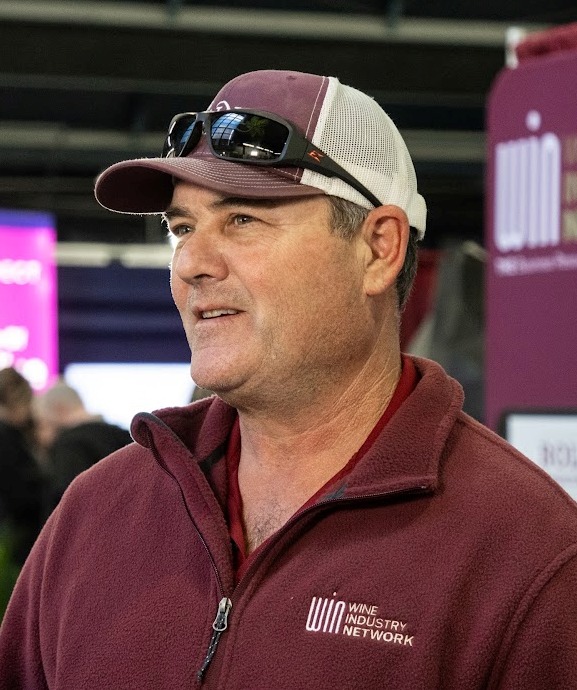
George Christie grew up in New Jersey. It wasn’t until college that he first visited California, but like many, once he came here, he fell in love with Sonoma County. He got his first big break in the wine industry working at Lake Sonoma Winery. Wine wasn’t a part of family life growing up, but he believes that not having much experience with wine actually benefitted him in the long run, and as he launched Wine Industry Network. Initially launched as an online directory, today WIN covers many aspects of the supplier side of the wine industry, including vineyard management, winemaking, sales, finance, marketing and leadership. Here’s George’s story.
When were you first introduced to wine—and when did you begin to really appreciate it?
I didn’t grow up with wine on the table, so when I first got involved in the wine industry, I was really worried it was going to hold me back. It took a long time for me to realize that, in some ways, not growing up with wine was actually good for me, because I had more in common with the general consumer than people who grew up in the wine business or wine country. Don’t get me wrong, I would have loved to have grown up in wine country or been born into a winery family, but that lack of exposure turned out to be helpful in the long run.
You grew up in New Jersey and came to Sonoma County after graduating from York College in Pennsylvania in 1989. What brought you west, how did you find your way into the wine industry, and who gave you your first break?
I’d never been to California, and like a lot of people who aren’t from here, it had this magical reputation — it was a place I really wanted to visit. I came out with a college friend who knew someone going to Sonoma State, and I got my first job at a health club in Healdsburg, selling memberships, which I’d also done in college. My original plan was to go to San Francisco, be successful, and go home. But like a lot of people, I fell in love with Healdsburg. It was surrounded by the wine industry and I decided to stay and see if I could build a career in wine. My big break came when Gary Heck, owner of Korbel, purchased a small winery I was working at — my first job in wine, at Lake Sonoma Winery. I owe a lot to Gary and the executive team at Korbel for giving me my first big break.
When you first arrived in Sonoma County, what did you think of it? Was there a particular moment when you realized, “I could make a life here”?
Anyone who’s ever been to Sonoma County knows how incredibly beautiful and diverse it is, so it didn’t take me long to fall in love with it. One of my first memories was driving from Healdsburg to Bodega Head, where the temperature changed something like 40 degrees within an hour — I went from 95 degrees and not a cloud in the sky to 55 degrees with the wind blowing like crazy and tsunami sized waves crashing on the rocks. It was pretty awesome and that’s when I started to think that Sonoma County was for me.

In 2009, you launched Wine Industry Network at a time when the industry was still relying heavily on print directories to find suppliers and services. What made you think there had to be a better way?
I remember walking around Unified Symposium in 2008 — I think it was the last hour of the last day — and wondering what those suppliers were going to do now that the show was over. I had a lot of experience on the winery side doing direct marketing, which was a fairly new thing we were all working on at the time, and I started thinking about applying some of those tactics to the vendor side. On top of that, I’d always been very involved in winery associations, and I thought it would be smart to model Wine Industry Network after the associations I’d been part of. Lucky for me, it worked out pretty well all these years later.
You’ve worked in almost every corner of the wine business—from vineyards and grower relations to winery operations, distribution, sales and marketing. Which of those experiences has had the biggest impact on the work you do today?
Because we work with vendors in every one of those categories, I can’t say any single experience had more of an impact than another. It’s really the culmination of that diversity of experience that’s allowed me to be a good partner and a smart marketer for the vendors we support, and to better understand the needs of our vineyard and winery partners.
WIN has grown from an online directory into a major B2B media, events and information platform. Looking back, was there a specific moment when you realized, “There’s a much bigger opportunity here”?
I can’t point to a specific day, or even a period of time, where I knew things were going to work. We just knew going in that we wanted to be the best business resource we could be, whether you were a vendor, a winery, a vineyard operation, a winery worker, and so on. We knew that if we kept our eye on the prize of being the best resource, the business would take care of itself — and over all those years, that’s basically what happened. We just kept adding more to what we had to offer, either as we thought of it ourselves or as our members requested it. Launching the WIN Expo was part of that — giving people a place to connect in person, not just online. I think that’s how most successful businesses work: they evolve and adapt, but they stay true to their mission.
You’ve served in leadership roles with organizations including Wine Road, Winegrowers of Dry Creek Valley and Sonoma County Vintners. From those experiences, what do you think the Petaluma Gap Winegrowers can do to best serve its members?
I believe the number one objective should be to listen — understand your members’ pain points and expectations, and make sure the association’s initiatives line up with what they care about most. The tricky part is that every member is a little different, so it’s not easy to make everyone happy. But you can make sure everyone is heard, and that comes down to being a good communicator: keeping members informed, being transparent about what the association can and can’t do, and following up so people know they were actually listened to.
From your vantage point, what makes an AVA truly stand out in an increasingly crowded wine landscape—and where do you see the greatest opportunity for the Petaluma Gap as a winegrowing region?
If you look at the most successful AVAs, they have a couple of things in common. There’s almost always a strong association behind the region, and they’ve identified what makes them different, what makes them unique — and that’s woven into all the marketing they do. What makes the Petaluma Gap special is its location and the coast’s influence on it — something you can’t convey through text, photos, or video. The best thing the Association can do is bring people to the region so they can experience it firsthand: the wind and the temperature swings that define the AVA, and the significant impact they have on the fruit grown there.
You recently added vineyard and winery real estate to your professional activities as a licensed real estate agent. Why did you decide to pursue it, and what is the market telling you right now about the future of Wine Country?
I’ve always been interested in the real estate side of our industry, but never had the time to dive in the way I needed to. In 2024, when the industry hit a real slowdown, I felt it was time to get serious — expanding what we do at Wine Industry Network to include being a resource for people buying or selling vineyard and winery properties. That’s when I got my real estate license. I’m also a partner at Saini Vineyards in Dry Creek Valley, so I’ve lived the ownership side of this too, which helps when I’m advising other owners. The benefit for people working directly with me, or with Wine Industry Network, is that we’ve got a pretty extensive set of experience across categories. But more importantly, it’s the network of industry experts I work closely with — from valuations to financing, vineyard management to winemaking, sales and marketing to leadership. We’ve got you covered.
Looking ahead, I expect a lot of activity over the next 24 months. The gap between what sellers think their property is worth and what buyers will pay has been too wide, but I see it shrinking — sellers taking a little less, buyers paying a little more. That’s good for the industry: fresh capital, and more importantly, fresh ideas.
After more than three decades in the wine business, what do you know now that you wish you’d known when you were starting out?
A couple of things. First, I wish I’d known that not growing up with wine was actually going to be a good thing for me, not a hurdle. I wish I’d paid more attention to opportunities on the vendor side instead of being so focused on the winery side, there’s a lot of really cool, innovative things happening there that I’m genuinely interested in. But probably most important, I wish I’d let some of the older industry professionals I worked with, who kept offering me advice, actually help me more. One of my flaws as a younger person was never wanting to ask for help, always trying to figure things out on my own, and now that I’m older, I realize that was a mistake. I know it because I really enjoy helping younger people and get as much out of it as they do, maybe more.

You met your wife, Tami, here in Sonoma County, and together you have built both a family and a business. What’s the secret to working all day with your spouse—and still looking forward to spending the evening together at home?
I’m lucky, because Tami’s family has owned a restaurant her entire life, so she grew up knowing what it’s like to have a family-owned business where everyone works together, and she understands the implications of that. Fast forward to today, we’ve been lucky to strike a really good balance between when it’s time to work and when it’s family time, while also knowing that sometimes you’ve got to take care of the business, whether it’s a weekend, a holiday, or a vacation. That’s just part of the deal, as anyone who works for themselves knows.
After all these years around extraordinary wines and winemakers, what do you like to drink when you’re at home, and nobody is watching?
I get this question a lot, and as a partner at Saini Vineyards, I’ve got to say, our wine is my go-to. But I love trying all kinds of wine — it depends on the situation: is it daytime or evening, am I having food or not, and if so, what kind. What I really love is having the chance to taste a bunch of different wines at the same time and comparing what I like or don’t like about each. Basically, wine exploration, for lack of a better term.